Shallow Convection
Sea Surface Temperature Anomalies and Trade Wind Cloudiness
These two recent work (Chen et al., 2023, 2025) provide complementary evidence showing that even weak, small-scale sea surface temperature (SST) anomalies in the Tropical Oceans can increase the formation rate of trade wind cumulus clouds on daily timescales, highlighting a fine-scale ocean imprints on the atmosphere that is currently not well represented in models where shallow cumulus is parameterized.
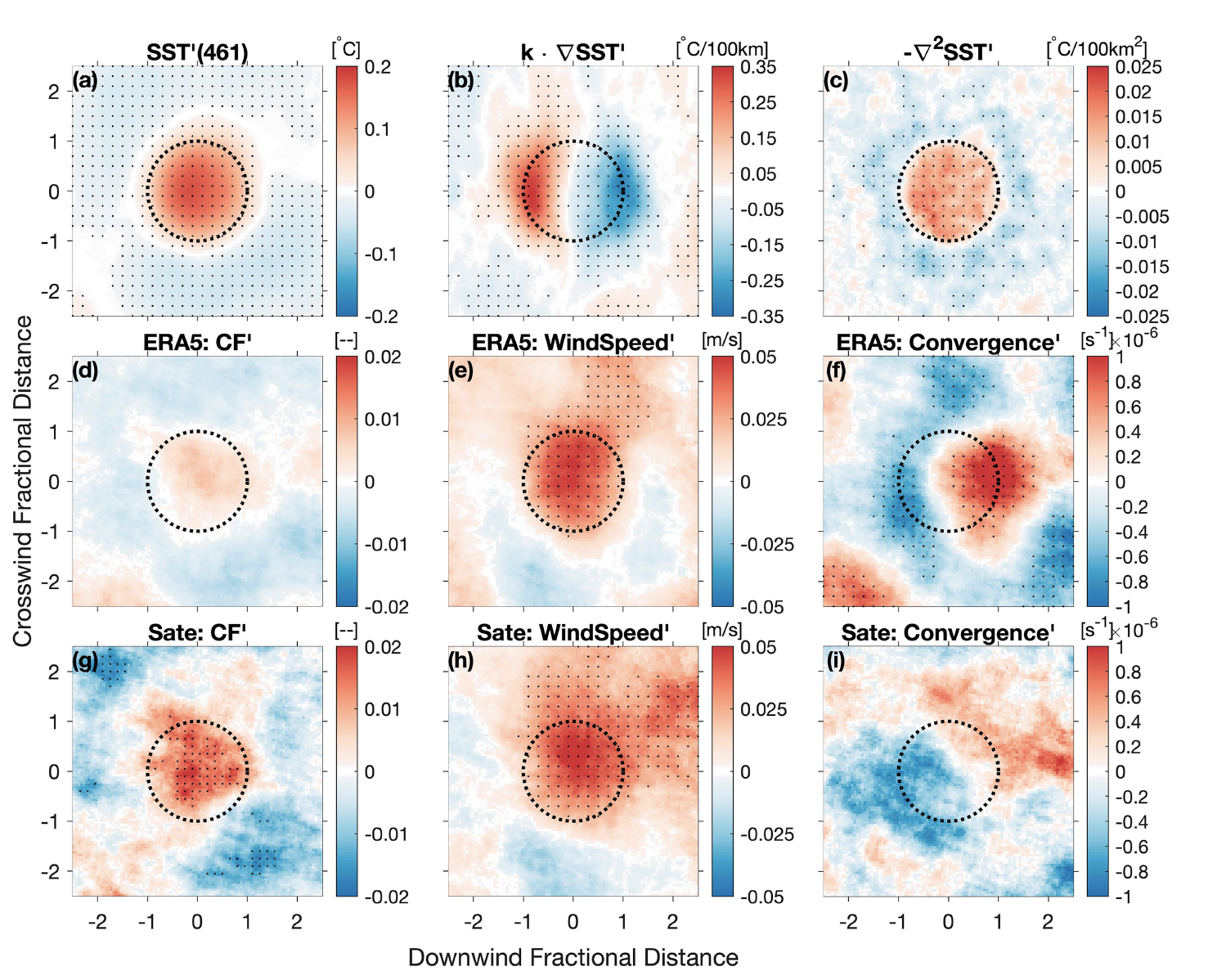
Using satellite observations that are validated by in-situ ATOMIC measurements, we found that ubiquitous SST anomalies in the tropical Atlantic increase the spatial heterogeneity of trade wind cloudiness, with warmer SST patches locally enhancing daily cloud fraction and cooler SST patches reducing it. The response patterns of surface wind speed and surface wind convergence further suggest that this cloud response is primarily tied to changes in surface-driven convective turbulence and fluxes rather than large-scale convergence.
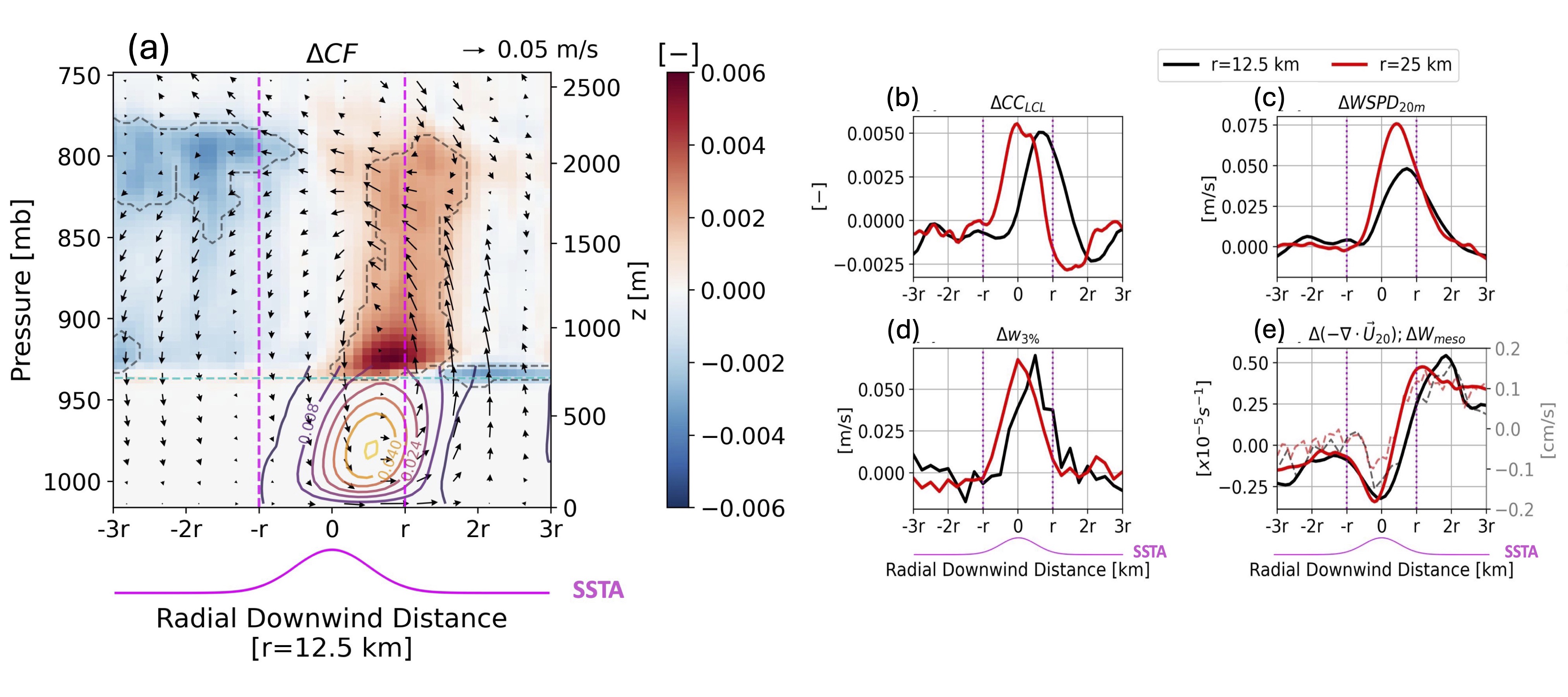
With idealized, 16-memeber ensemble Large-Eddy Simulations (LES), we qualitatively reproduced the satellite composite results showing above. The numerical experiments helped clarify that the enhanced cloud fraction seen in the satelite composite can be primarily attributed to a robust increase of near-LCL cloudiness over warm SSTAs, which is generated by enhanced convective updrafts in the subcloud mixed layer over SST warm anomalies.
So what does these findings mean for climate and weather models?
Answering this question would require more investigations looking into the potential downstream impact on mesoscale cloud organization (which likely exerts bigger impacts on radition, precipitation, and the atmospere mean state). One of my guess/hypotheis is that correctly representing the atmospheric responses to the O(10-100 km) SST anomalies in this relatively weak regime could help increase the coupling strength at mesoscale and finer in the tropics, because mesoscale air-sea coupling strength are tends to be weaker in models than in observations (30% reported for the Western Bundary Current regions in Masunaga and Schneider 2022). If we could improve the representations of these responses in climate and weather models, we could then demonstrate the impact using controlled experiments.
Publications
- Chen, X., Dias, J., Wolding, B., Blossey, P. N., DeMott, C., Pincus, R., & Thompson, E. J. (2025). Impacts of Weak Sea Surface Temperature Warm Anomalies on Local Trade Cumulus Cloudiness in Large Eddy Simulations. Journal of Advances in Modeling Earth Systems. [DOI]
- Chen, X., J. Dias, B. Wolding, R. Pincus, C. DeMott, G. Wick, E. J. Thompson,and C. W. Fairall (2023). Ubiquitous Sea Surface Temperature Anomalies Increase Spatial Heterogeneity of Trade Wind Cloudiness on Daily Time Scale. Journal of Atmospheric Sciences. [DOI]
Talks
2024-04-25: Mesoscale Sea Surface Temperature Warm Anomalies Increase Trade Cumulus Generation in North Atlantic Trades: Satellite Observations & Large Eddy Simulations, Mesoscale & Microscale Meteorology seminar at NSF NCAR, Boulder, CO. [watch here]
2023-01-12: Trade Cumulus Cloudiness Modulated by Weak Sea Surface Temperature Anomalies during Atlantic Tradewind Ocean-Atmosphere Mesoscale Interaction Campaign, 103rd Amer. Meteor. Soc. Annually Meeting, Denver, CO. [watch here] (recording requires access to AMS)
← Back to Research Portfolio