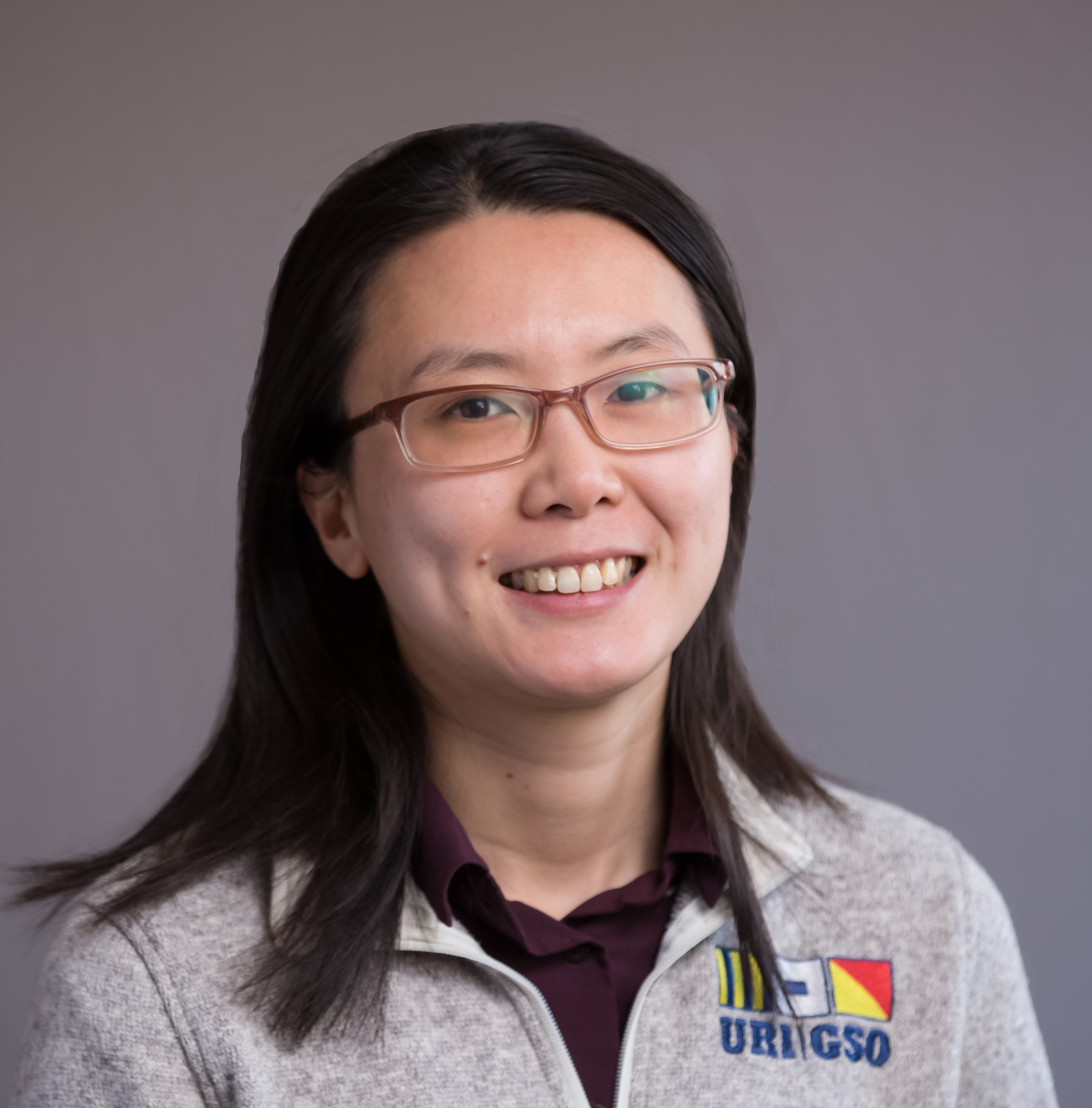
I came to Ocean Sciences half by choice and half by pure chance. I knew I would prefer to study environmental sciences and learn about nature, so one of the majors and universities I applied for was marine science at Ocean University of China (OUC). In my junior year at OUC, I was searching for meaning in what I studied. Growing up in southern China, my frequent experience of typhoons helped me to connect the Ocean and extreme weather systems. Also, the practical aspect of numerical modeling and forecasting appealed to me at that time.
Connecting what I do with meaningful societal needs helped me continue studying Ocean Sciences toward a career in Physical Oceanography. My curiosity about the novel aspect of hurricane-ocean surface wave interactions eventually led me to pursue a doctoral degree with Dr. Isaac Ginis and Dr. Tetsu Hara at the University of Rhode Island. After completing my doctoral research about the impacts of shoaling ocean surface waves on wind stress and storm surge, I realized that my interest in this research topic had not continued to grow, especially because the modelling limitations in my doctoral research could only be improved further by observations. Also, I started to wonder whether small-scale variability in air-sea fluxes affects the atmosphere on time scales longer than synoptic. So, I actively sought opportunities to work on a different research topic within air-sea interaction to expand my horizon during my postdoc.
This new curiosity and some luck led me to an observation-based postdoc project at CIRES, where I investigated the impacts of sea surface temperature (SST) spatial variability on shallow cumulus clouds over the Northwest Tropical Atlantic, working with scientists at NOAA Physical Sciences Laboratory. It was almost like a second doctoral project to me, but I was able to transfer what I learned in my graduate coursework and apply my numerical modeling skills to this project. Over the past 3-4 years, my research, combining in-situ observations, satellite observations, and idealized large-eddy simulations, shows that weak yet ubiquitous SST warm anomalies spanning 10-100 km in the Northwest Tropical Atlantic increase the daily trade cumulus cloudiness locally below 1 km by increasing the frequency of turbulence-driven cloud generation. Using a Lagrangian framework, I am currently searching for this potential downstream cloud response in satellite observations.
I think good researchers always stay in learning mode. Following the trend of applying Machine Learning and Artificial Intelligence in Geosciences, I’m now learning to use this powerful new tool to uncover more hidden rules of the coupled ocean-atmosphere system from different data sources for the benefit of society.