Storm surge
Shoaling Waves Amplify Coastal Storm Surge
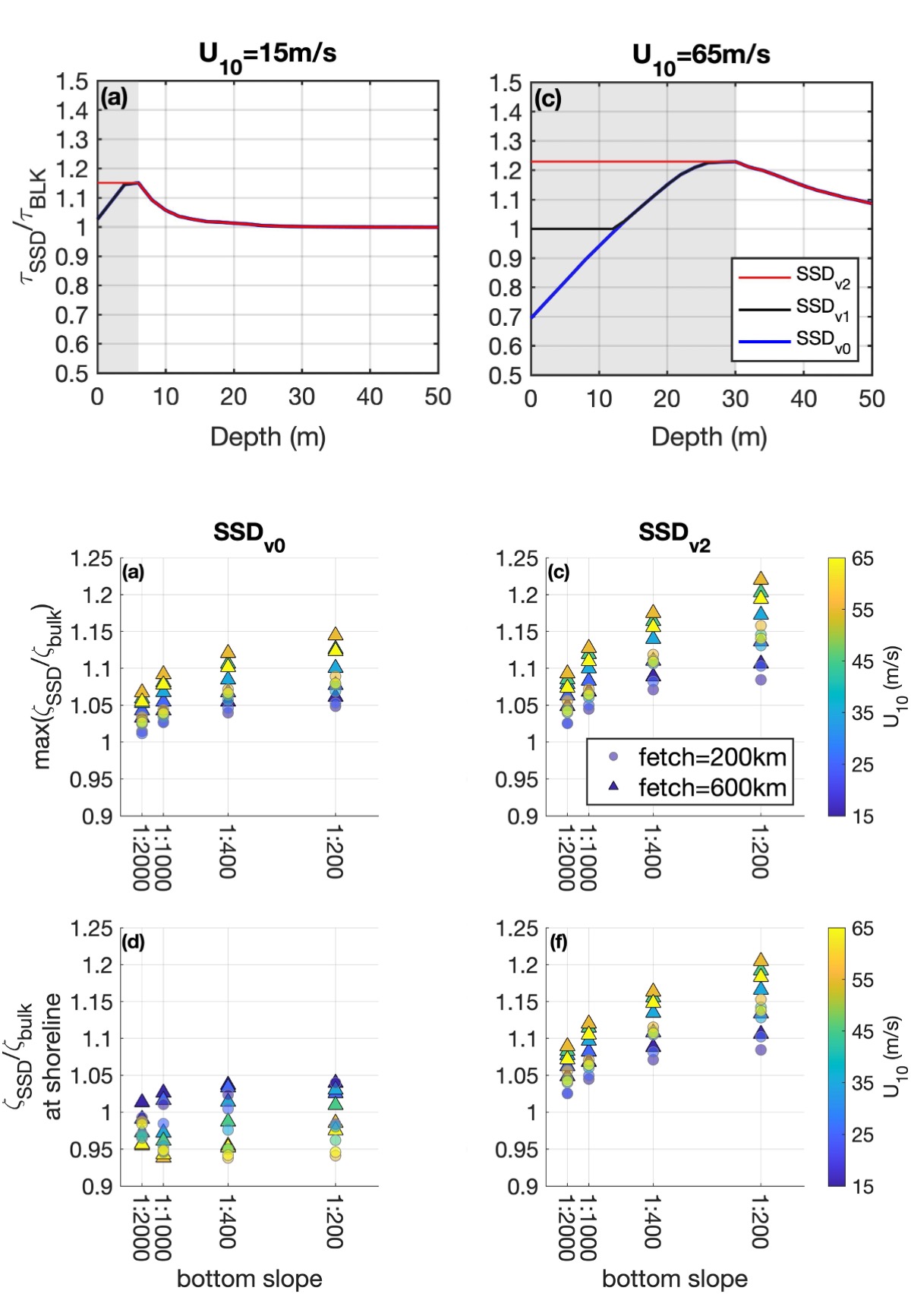
Storm surge occurs when strong winds push ocean water toward the coast. In storm surge models, this wind force on the ocean is represented by wind stress, which is traditionally calculated solely from wind speed. This study examines how wind stress affected by waves that slow down and steepen near the shore (shoaling waves) changes the predicted sea level during storms. Using a combination of a simple surge model, the ADCIRC storm surge model, and wave information from the WAVEWATCH III model, we find that accounting for shoaling wave effects on wind stress increases storm surge level by up to 15% relative to the traditional wind speed-based formulation under steady onshore winds. For tropical cyclones, wave-modulated wind stress mainly increases sea level drop on the left side of the storm track, with negligible impact on the peak surge on the right side of the storm track. Overall, the results suggest that wave-modulated wind stress plays a greater role in long-lasting onshore wind events, such as extratropical storms, and that accurately predicting storm surge level at the shoreline requires a better understanding and modeling of wind stress in the surf zone.
Publications
- Chen, X., Ginis, I., Hara, T. (2026). Impact of Shoaling-Wave-Modulated Wind Stress on Storm Surge Modeling. (submitted to JGR:Oceans).
- Chen, X., Ginis, I., Hara, T. (2020). Impact of Sea-State Dependent Wind Stress on Storm Surge. URI Open Access Dissertations.(Chapter 4, unpublished). [DOI]
Talks
2021-04-21: Implementation of a Flexible ADCIRC-WAVEWATCH III Coupling System, DHS Coastal Resilience Center 6th Annual Meeting, virtual. [watch here]
← Back to Research Portfolio